Hackathons vs Coding Interviews: Which is Better for Hiring Developers
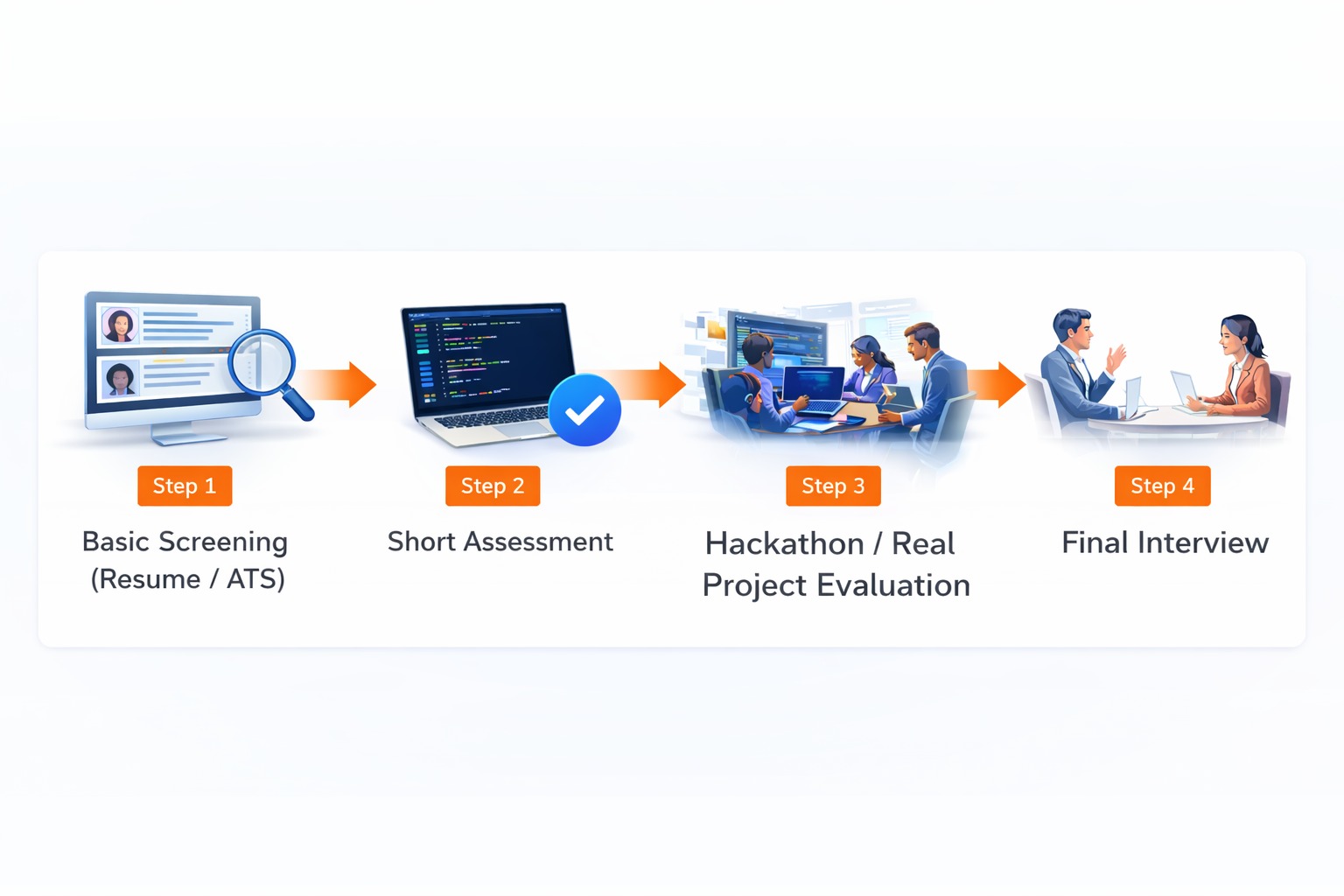

TL;DR: Traditional coding interviews test algorithmic recall in a high-pressure environment, while digital hackathons evaluate practical, job-ready skills like code architecture and teamwork. For organizations looking to hire developers who can build real software rather than just solve puzzles, experiential assessments provide a far more accurate and scalable hiring signal.
What Is a Coding Interview vs a Digital Hackathon?
A coding interview is a time-restricted technical assessment where candidates solve abstract algorithmic problems (often on a whiteboard), whereas a digital hackathon is a structured experiential assessment where candidates work on realistic project features to demonstrate their practical engineering skills and workflow discipline.
For years, the technology industry relied heavily on algorithmic quizzes to filter candidates. However, as the demands of modern software development have evolved toward complex system design, API integrations, and collaborative workflows, the limitations of traditional interviews have become glaringly apparent.
Why Experiential Assessments Outperform Traditional Interviews
Relying solely on whiteboard coding is akin to testing a chef by asking them to write a recipe on a chalkboard rather than having them cook a meal. Shifting to project-based evaluation matters because:
- It measures real-world application — Knowing how to invert a binary tree rarely correlates with the ability to build a scalable microservice.
- It reduces false negatives — Many exceptional engineers suffer from interview anxiety and perform poorly under artificial time constraints.
- It evaluates soft skills — Digital hackathons naturally test communication, teamwork, and how candidates respond to feedback, which isolated coding tests completely miss.
How Digital Hackathons Solve Interview Flaws
Parallel, Automated Evaluation
Coding interviews require a 1:1 ratio of senior engineers to candidates, creating a massive bottleneck. Digital hackathons allow companies to evaluate hundreds of candidates simultaneously, freeing up thousands of engineering hours.
Focus on Code Intelligence
Instead of checking if an algorithm simply outputs the right number, hackathon platforms like TeamCraft measure "code intelligence"—evaluating architecture, maintainability, variable naming, and modularity.
Observability of Workflow
In a hackathon, evaluators can view a candidate's Git commit history and pull request structure. This reveals whether a candidate works methodically or haphazardly, providing a critical signal for long-term job success.
Practical Steps to Transition Your Hiring
- Start with a hybrid approach — Use digital hackathons for the technical screening phase, followed by a final cultural fit interview.
- Define clear evaluation metrics — Decide upfront if you are prioritizing speed, code quality, or teamwork.
- Communicate expectations to candidates — Ensure applicants understand they are being evaluated on professional workflows, not just raw output.
Common Mistakes in Technical Evaluations
- Relying entirely on puzzle-style questions — Filtering candidates strictly by their ability to solve obscure math problems eliminates talented product engineers.
- Over-indexing on speed — Forcing candidates to rush leads to sloppy code. Real engineering requires thoughtful planning and testing.
- Evaluating candidates in isolation — Failing to test collaboration means you risk hiring brilliant jerks who destroy team morale.
- Ignoring code maintainability — An answer that passes the test cases but is completely unreadable is a failure in a real production environment.
- Creating stressful, unnatural environments — Watching a candidate code live over screen-share introduces artificial panic that doesn't reflect their day-to-day performance.
Coding Interviews vs Digital Hackathons
| Feature | Traditional Coding Interview | Digital Hackathon Assessment |
|---|---|---|
| Core Focus | Algorithmic recall and puzzle solving | Software architecture and project execution |
| Environment | High-pressure, live observation | Asynchronous, realistic development environment |
| Scalability | Low (requires 1:1 engineering time) | High (parallel evaluation via AI/automation) |
| Soft Skills | Rarely assessed | Directly observed via team collaboration |
| Validity | Weak predictor of job performance | Strong predictor of on-the-job success |
FAQ
What is the difference between a coding interview and a digital hackathon? A coding interview tests theoretical algorithm knowledge in a short, high-pressure session, while a digital hackathon assesses practical project-building skills over a few days in a realistic environment.
Do digital hackathons take more time than coding interviews? For candidates, hackathons may take a few hours spread over a weekend. For companies, hackathons save massive amounts of time by automating the evaluation of large candidate pools.
Can we completely replace coding interviews? Many modern companies have entirely replaced live coding interviews with experiential assessments, reserving live calls purely for architectural discussions and team-fit evaluations.
How do we assess algorithms in a hackathon? Algorithms are assessed naturally within the context of the project. If a candidate needs to sort large datasets or optimize a search function within their application, their algorithmic competence will be evident.
Do candidates prefer hackathons over technical interviews? Yes. Data shows that candidates heavily prefer experiential assessments because they are less stressful, closer to actual engineering work, and provide a fair opportunity to showcase their true capabilities.
Conclusion
The shift from coding interviews to digital hackathons represents a maturation in how the industry identifies talent. By moving from theoretical puzzles to experiential assessments, companies can build stronger, more collaborative engineering teams while drastically reducing the time burden on their senior staff.
If you want to hire developers who can actually build and scale software, you must evaluate them on their ability to do exactly that.
Ready to transform your tech hiring?
Start evaluating candidates based on real-world capabilities, not just resumes.